
Berlin, Monday, June 22-27, 2026
The drive to the Dubrovnik airport is spectacular: the road twists and turns high above the sea, with views onto islands near and far. The airport is small and easily negotiable, and the two Austria Airlines flights (change in Vienna) were comfortable.

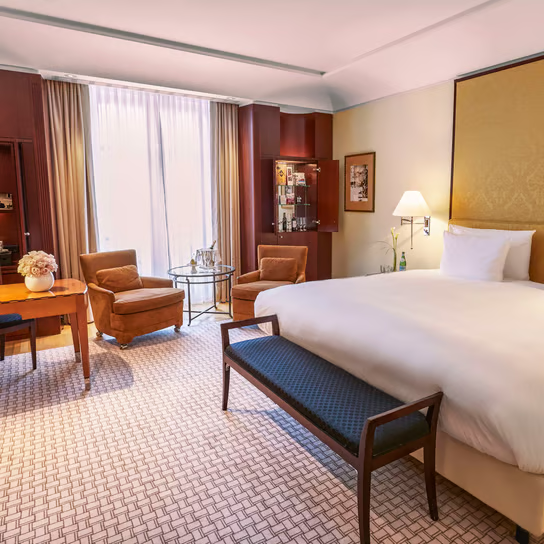
We were soon checking into our room at the Hotel Adlon, the ritziest joint in town. We still don’t understand how we got a room for a bit more than 300 Euros a night.

We were totally spoiled by our room.
We had gotten up early, so we relaxed for a while until Sue indulged me in my love of Bavarian food…which they serve up in style at a place called Maximilian’s. I managed to eat most of a Schweinshaxe in honor of our son and his love of the dish!

We walked home through the Gendarmenmarkt, the most beautiful corner of a city that is generally more interesting than beautiful.

The Adlon is on Pariser Platz, looking onto the Brandenburg Gate.

After dinner we took a walk out through the gate and, turning right, arrived at the Memorial for the Murdered Jews of Europe.

The memorial was controversial from the day it was approved. I’ve always found it deeply moving. Peter Eisenmann’s memorial manages to evoke both a graveyard and a gently rolling landscape or seascape. Obviously I’m not the only one who finds the memorial an incentive for meditation.

We started Wednesday with a walk through one of the best preserved parts of old Berlin, the area north of Hackescher Markt. A visit to the Hackeschen Höfe is the mandatory starting spot. The main courtyard was decorated in 1905by the important architect and theorist August Endell.

The building is typical of the district: a series of progressively smaller courtyards receding from the street. The Sophienstraße, just behind the Höfe, is full of similar buildings.
The Sophienkirche is notable as the site of Martin Luther King’s only sermon in the German Democratic Republic.

It was already hot, but we decided to walk through the Scheunenviertel, once home of many of Berlin’s Jews, and on to the Dorotheenstädtischer Friedhof. This is the facade of the Neue Synagoge.

Opened in 1866, the synagogue was desecrated during the pogrom of November 9, 1938; although it was restored and reopened as a place of worship, it was reduced to a ruin by allied bombing runs staring in 1943.
The Dorotheenstädtischer Friedhof is, in terms of those buried here, the most culturally significant in Germany. The list of central figures is long: Hegel, Fichte, Brecht, Helene Weigel, Hans Eisler, Harun Farocki, John Heartfield, Heiner Müller, the list goes on.

The cemetery is a lovely, restful place. But we were there to pay respects to two people I knew well: Alexander and Alexandra Kluge.
On the way home we visited the museum in the building known as the Tränenpalast, or palace of tears. It was the building where visitors from the west were “checked” before being granted admission to the socialist paradise. Sue and I were there in 1980, and it was a humiliating experience. Jimmy Carter had announced a boycott of the Moscow Olympics, and the minions of this Soviet client staff weren’t about to make life easy for Americans. The museum is very well done, with a real sense of how human beings were “processed.”

We spent the afternoon in the west. As we got off the bus near the Kurfürstendamm, we were immediately struck by the change in atmosphere: streets thronged with people, streets lined with stores. By comparison, the east is still a ghost town. The effort to revitalize Friedrichstraße south of Unter den Linden has failed; the Galeries Lafayette, the high end French department store (with an iconic building by Jean Nouvel), intended as an anchor, has closed. The trendy districts (e.g. Prenzlauer Berg) are a bit livelier, but they’re clogged with bars and restaurants and little to support life if you’re over 26. We walked around the incredible food floor at KaDeWe, the big luxury department store in the west, mostly to think about Andrew eating crepes with strawberries and cream from LeNotre…it was what kept him happy when we lived in Berlin.

A drink at a bar on the lovely Savignyplatz brought us to dinner time, and a nice Vietnamese meal at a joint called Madame Ngo.
Wednesday brought me to the Kluge Archive; I found much more than I anticipated, and I worked there part of every day for the rest of our stay. Sue, on the advice of a friend, tried to swim at one of the public pools, the Sommerbad Kreuzberg, but the scene was totally chaotic: too many people, only three lanes, and at least ten people in every lane. She got in half a mile and called it good. She went from there to the Gemäldegalerie in the KulturForum, where the Prussian royal collection is housed. I joined her late in the afternoon, and raced through the galleries. Incredible early German art, incredible early Italian.
Evening took us back to the west and a terrific meal at Brasserie Lamazère: prawns in a lemon cream followed by wagyu shoulder and one of the best rice puddings ever.

Thursday was another work day for me. Sue started her day with a visit to the Berlin Wall Memorial in the Bernauerstraße. The memorial is built around a preserved section of the wall, including a watchtower, mined strip, patrol paths…the whole, wretched thing.

The weather had now definitely turned: the weather talking heads are talking about a “heat dome” of air from North Africa. But we soldiered on. I met Sue mid-afternoon and, after grabbing a cooling ice cream, we visited the Alte Nationalgalerie on the Museum Island. The museum is dedicated to German art from the late eighteenth to the early twentieth century, with spectacular holding in Caspar David Friedrich and Adolph Menzel. The highlight, though, was a huge show dedicated to the gallerist Paul Cassirer. Cassirer was the scion of a prominent and very wealthy Jewish family; his cousin was the philosopher Ernst Cassirer. He opened a “Kunstsalon” through which he became the leading voice for modern art: from Impressionism on. The show included great art, and each painting included information on its provenance: when Cassirer exhibited it, who bought it, how it arrived in public collections. This is Cassirer in a portrait by Leopold von Kalckreuth in 1912. Personal side note: I came to know Peter Paret, a German historian at the Institute for Advanced Study in Princeton. He told me a great deal about Paul Cassirer: his grandfather!

Dinner was less of a success. We ate at a place called Estelle in Prenzlauer Berg, a small, very personal restaurant run by an American chef and his German wife. The food was good, but very poorly judged for the scalding weather.
Friday was my last day in the archive. I didn’t want to bore you, dear reader, with the rather esoteric work of the scholar. But I should share an important artifact. The archive includes material on Walter Benjamin (the staff know me well), Alexander Kluge, and Theodore Adorno. Adorno offered a famous verdict on capitalist society: Es gibt kein richtiges Leben im falschen (There can be no right life in the false). This sentiment was condensed during the student revolts of the 1960’s into the following motto:

After work, we tried to escape the heat by acting like a Berliner and heading to one of the many lakes in the nearby countryside. We were advised against many of the prettier, smaller lakes because their small beaches would be overrun. So we headed for the beach at Wannsee. S-Bahn to Nikolaussee and then a mile walk through the forest. The beach is actually huge, and very developed. We rented an umbrella and a lounge chair and set up camp. Unfortunately, this was a bust, too. The extreme heat had caused a massive algae bloom: the water near the beach was tepid, and, as you waded out and the water cooled, the seaweed started to tangle around your feet. We were strongly advised not to put our heads in the water!
The evening was very nice. We met our friends Joseph and Ethel for dinner at Sale e Tabacchi, a long-established Italian restaurant frequented by artists and intellectuals. We were just eating our first courses when the lights went out. The heat had caused a power outage all down the street, and the restaurant could no longer serve hot meals! Sue and I quickly shared our starters (burrata and vitello tonnato) with Joseph, who hadn’t ordered one, and we all had small mixed salads for a main course. It made for a memorable evening which lasted, despite the reduce fare, for more than three hours.